
When it comes to numbers, 40 isn’t just another face in the crowd. It’s a superstar, strutting its stuff with a dazzling array of factors. But wait—there’s more! These factors don’t just hang out solo; they come in pairs, ready to team up and take on the world. If you’ve ever wondered how these dynamic duos work, you’re in for a treat.
Understanding Factors of 40
Factors play a crucial role in understanding the structure of numbers like 40. Identifying these components helps in grasping their relationships and functionalities.
Definition of Factors
Factors represent integers that divide another integer evenly, leaving a remainder of zero. For example, the factors of 40 include the numbers 1, 2, 4, 5, 8, 10, 20, and 40. Each factor pairs with another. In this case, 1 pairs with 40, 2 with 20, 4 with 10, and 5 with 8. By understanding these pairs, individuals can comprehend how factors express the mathematical relationships within a number.
Importance of Factors in Mathematics
Factors contribute significantly to various mathematical concepts, including multiplication and divisibility. Identifying factors assists in simplifying fractions, solving equations, and finding greatest common divisors. Factors also play a vital role in number theory, facilitating deeper insights into prime numbers and composite numbers. Learning about factors enhances problem-solving skills, providing a foundation for more complex mathematical concepts. Understanding 40’s factors aids in grasping broader mathematical applications, reinforcing their importance in the field.
Finding Pairs of Factors of 40
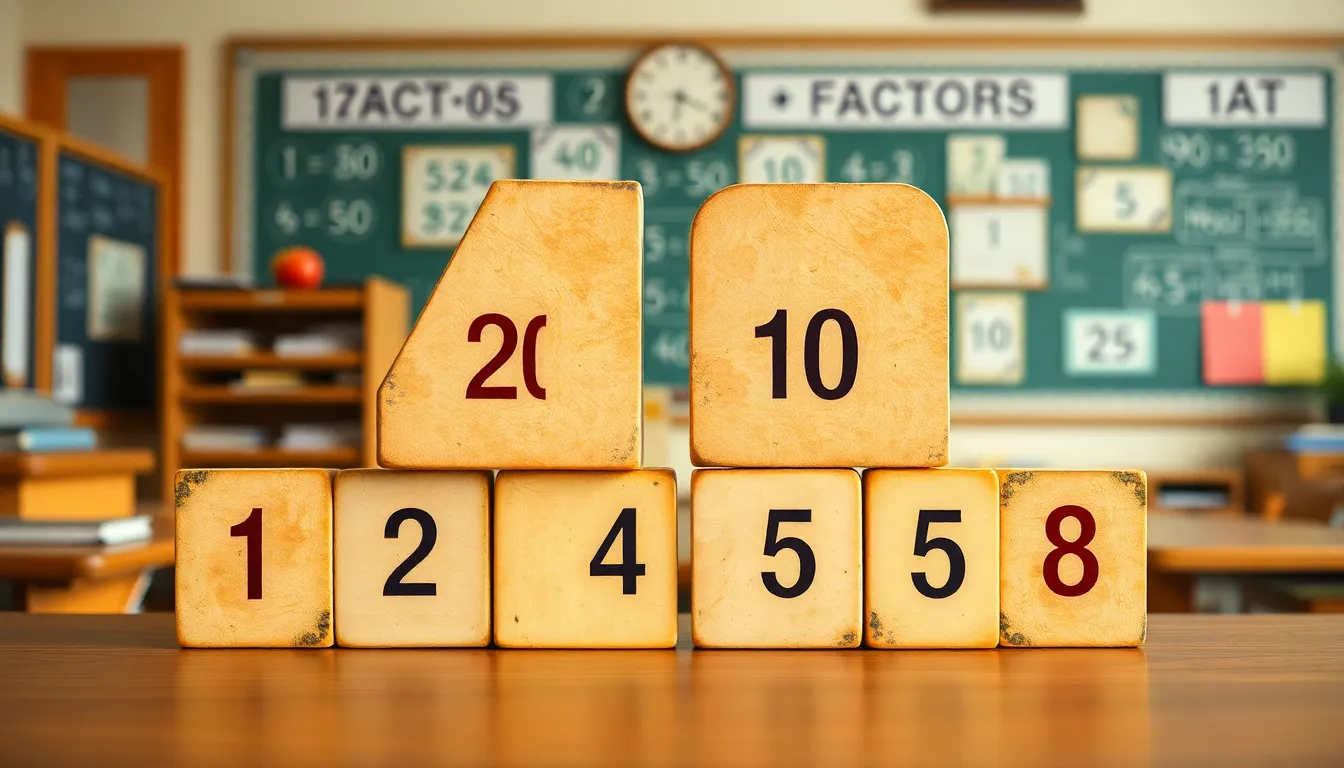
Understanding pairs of factors helps in grasping the concept of multiplication and divisibility. The number 40 has several factors that come together in pairs.
List of Factors of 40
The factors of 40 include 1, 2, 4, 5, 8, 10, 20, and 40. Each factor divides 40 evenly without leaving a remainder. When examining these factors, a complete list becomes crucial for identifying pairs.
Identifying Pairs
Pairs of factors for 40 emerge as 1 and 40, 2 and 20, 4 and 10, and 5 and 8. Each pair multiplies to create the original number, confirming their relationship. Recognizing these pairs simplifies mathematical operations and aids in problem-solving. Familiarizing with these combinations enhances one’s understanding of basic arithmetic and number theory.
Properties of Factor Pairs
Understanding factor pairs of 40 reveals several important mathematical properties.
Multiplicative Properties
Multiplicative properties describe how factors interact through multiplication. Each pair, including 1 and 40, 2 and 20, 4 and 10, and 5 and 8, demonstrates this concept. For example, multiplying the factors of 4 and 10 equals 40. This relationship underlines how pairs directly relate to the original number. Recognizing these pairs aids in performing multiplication tasks efficiently. The simplicity of factor pairs allows for more effective problem-solving. Grasping this concept enhances familiarity with division and factors.
Commutative Property
The commutative property emphasizes that the order of factors does not affect the product. For instance, 2 multiplied by 20 yields the same result as 20 multiplied by 2. This property applies to all pairs of 40’s factors. The factors can switch places without altering the outcome, reinforcing flexibility in calculations. Understanding this property simplifies working with numbers. It also connects to larger mathematical principles, making it easier for students to engage with challenges. Both the commutative and multiplicative properties enhance overall mathematical comprehension.
Applications of Factors of 40 in Real Life
Understanding factors of 40 extends beyond mathematics into everyday scenarios. These factors simplify calculations and provide insights into problem-solving.
Practical Uses in Everyday Calculations
Factors of 40 enhance efficiency in daily calculations. When dividing items evenly, factors simplify groupings. For example, organizing 40 apples into bags of 5 lets individuals create 8 bags effortlessly. Additionally, budgeting becomes straightforward when applying these factors, allowing for easy division of expenses. By leveraging factors, tasks like measuring ingredients in recipes become less complicated, as one can use 1, 2, 4, 5, 8, 10, 20, or 40 as convenient measures.
Examples in Problem Solving
Recognizing factors of 40 supports effective problem-solving strategies. Pairs like 4 and 10 illustrate how to simplify multiplications, making calculations faster. When faced with a challenge like finding common denominators, knowing the factors expedites the process. For instance, determining how many groups of 8 fit into 40 becomes manageable with recognized factor pairs. Each factor pair aids in visualizing relationships, thus fostering a deeper statistical understanding in various scenarios.
Understanding the factors of 40 in pairs reveals the interconnectedness of numbers and their roles in mathematics. Each pair not only reinforces the concept of multiplication but also highlights the beauty of mathematical relationships. This knowledge extends beyond theoretical applications, finding relevance in everyday tasks like budgeting and cooking.
By recognizing how these factors interact, individuals can enhance their problem-solving skills and simplify complex calculations. The insights gained from exploring the factors of 40 serve as a foundation for deeper mathematical exploration, ultimately enriching one’s understanding of number theory and its practical implications.